|
|


ON SHOW
BY THE BOOK
11 NOVEMBER - 31 DECEMBER
Halil Altındere’s solo exhibition “By the Book” opens at PİLOT on November 11. On view through December 31, 2026, the exhibition brings together works produced by the artist across different periods, spanning sculpture, video, photography, painting, carpets, and miniature painting.
Altındere focuses on methods of resistance in the face of power and oppression, exploring subjects such as subcultures, gender roles, popular culture, the ordinary miracles of everyday life, and power struggles both within and beyond the art world. Examining under a magnifying glass the absurd yet very real details that history has thrust upon the masses, Altındere considers the delicate balance between miracle and revolution, crisis and routine, dream and nightmare, and resistance and oppression through games, toys, monuments, heroes, and figures, documents, and objects regarded by society as “defective,” “sinful,” or “other.”
The artist’s longstanding interest in traditional arts, particularly Ottoman miniature painting and craftsmanship, continues in his new works. In Optimus Robot at the Hammam (2026) and Atlas Robot at the Hammam (2026), Altındere explores the concepts of the hammam, water, bathing, and purification through miniature scenes rendered on large-scale surfaces, introducing contemporary technologies, which have become increasingly prominent in his practice in recent years, into compositions inspired by Ottoman miniatures. By placing robots developed by companies such as Boston Dynamics and Tesla within the hammam settings of these miniatures, he creates scenes situated in a distinctive temporality that belongs neither to the past nor to the future. Hammam bowls carried by drones and robots performing traditional body scrubs envision a cold reality in which some of humanity’s most vulnerable and exposed moments are taken over by robotic technologies.
Altındere’s close engagement with Ottoman visual culture continues in Ottoman Lux: Chanel Clogs (2026) and Ottoman Lux: Chanel Hammam Bowl (2026), which bring traditional craftsmanship together with the imagery of contemporary luxury consumption. By placing the Chanel logo on nalın (traditional wooden bath clogs) and hammam bowls, objects associated with Ottoman bathing culture, the artist examines the relationship between ostentation, wealth, and power. The appearance of such displays of luxury in the hammam, a place of purification and simplicity, creates a contradiction between what individuals shed and what power refuses to relinquish. This display of extravagance continues in Ottoman VIP: A Wedding Procession (2024), this time through an Ottoman wedding procession. Comprising fourteen sections in an accordion-fold murakka format, the work introduces luxury brands such as Hermès and Louis Vuitton into a historical wedding procession, calling into question the continuing significance of ostentation as a means through which those in power present themselves.
The final group of works in the exhibition drawing on Ottoman visual culture, Hamse-i Atâî (2021), is presented as a series of six works arranged in three diptychs. Taking inspiration from Hamse, a collection of five mesnevis by the seventeenth-century Ottoman poet Nev‘îzâde Atâyî, and its illustrated manuscript versions, Altındere focuses on the symbolic language of narratives dealing with everyday life and human relationships. Through the forms, colours, and structures of flowers, the artist reinterprets meanings embedded in relationships that are not directly expressed.
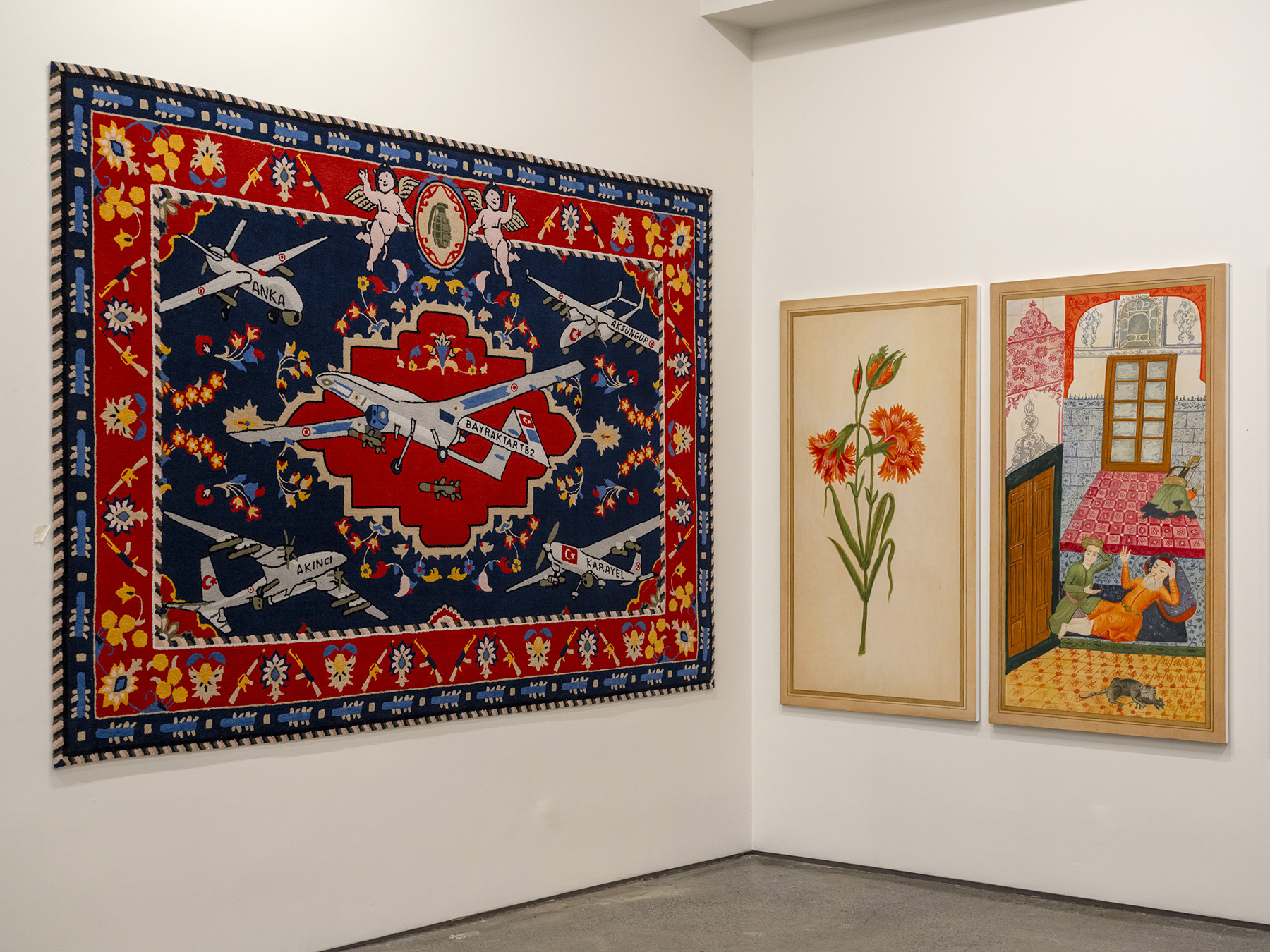
Extending his engagement with Ottoman craftsmanship into woven surfaces, Altındere approaches the carpet as a cultural and historical medium in Turkish Unmanned Ground Vehicles Rug (2024) and Turkish Military Drones Rug I–II (2023), displayed side by side in the exhibition. Drawing on Afghan war rugs, which began to emerge in the late 1970s, these works reflect on how political and social transformations become embedded in traditional forms of production. During the wars in Afghanistan, images of tanks, rifles, grenades, and helicopters began to appear among traditional carpet motifs, revealing how the conflicts and upheavals of the period found expression in textile traditions. In his own carpet series, Altındere similarly incorporates contemporary unmanned aerial and ground vehicles, military drones, and new-generation weapons technologies into traditional patterns.
Security and surveillance, recurring concerns throughout Altındere’s practice, occupy a central position in the exhibition with Security Tree II (2026). Revisiting a work previously conceived in the form of a cypress tree, the artist reinterprets it for Manifesta in 2026, constructing a four-metre-high structure made of stainless steel and seventy surveillance cameras. Reconstructing the form of a tree through surveillance technologies, the work questions the relationship between security and mechanisms of constant monitoring and control.
The relationship between the observer and the observed is reversed in Sleeping Security Guard (2019). In this silicone sculpture depicting a sleeping museum security guard, the person normally responsible for watching visitors becomes a figure subjected to the viewer’s gaze. The surveilling gaze also continues from above: in Angel (2017), the image of a guardian angel is transformed into a winged surveillance camera, prompting the question: Where is the boundary between protection and control?
In another new work in the exhibition, the oil painting Drone Killer (2026), Altındere introduces nature into his ongoing exploration of the relationship between humans and technology. Inspired by the training of eagles at Amsterdam Airport approximately a decade ago to intercept unauthorised drones, the artist questions the idea of technological progress through the irony of turning back to nature to solve problems created by advanced technological systems. Previously realised as a bronze sculpture, the work is now translated onto canvas in the form in which it was originally conceived.
Ballerinas and Police (2017), this time directed at the representation of authority through the body. Depicting masked and armed riot police officers wearing ballet pointe shoes, the work brings the aesthetic language of ballet, associated with grace and discipline, into contact with the body of the police officer, a figure representing force and authority. By bringing these seemingly distant worlds together within a single body, Altındere defamiliarises a familiar image of authority while questioning the meanings attached to it.
Resist (2025) draws on the forms of expression developed by younger generations during the 2025 Saraçhane protests. Depicting Karl Marx and Pikachu, who became one of the symbols of the protests, within the same demonstration, the painting explores the transformation of humour into a central means of expression in contemporary protest culture. The question of how social events become embedded in public memory finds another response in Hrant (2015). Comprising one thousand metal coins bearing the portrait of journalist Hrant Dink, who was murdered in 2007, the work draws on the tradition of depicting historical figures on coins. By bringing these one thousand coins together, Altındere gives Dink’s memory a form that multiplies, repeats, and acquires permanence.
Another work tracing recent history through everyday objects, Havaianas (2026), is a new version of Altındere’s 2013 bronze sculpture Mekap. This time casting flip-flops in bronze, the artist establishes an implicit connection between the social and political atmospheres of different periods. The years that have passed and the changing footwear also serve as reminders of issues that remain relevant today.
Those excluded from society, those unable to find a place to belong, and figures who challenge the boundaries of established roles have long occupied an important place in Altındere’s practice. Neverland (2019) originated from the idea of a fictional pavilion belonging to no country, conceived by Altındere for the 2019 Venice Biennale. Intervening in the pavilion system, one of the art world’s most established traditions of national representation, through its own architectural language, the artist questions where stateless people, refugees, and those who belong nowhere might find a place within this structure. He designs an architectural structure consisting solely of a front façade. The exhibition presents a painting produced in preparation for the pavilion.
In 1st Intergalactic Art Biennial (2019), also conceived for the 2019 Venice Biennale, Altındere reimagines the idea of national representation beyond the boundaries of Earth. Set in the fictional year 2079, this imagined biennial features ninety colonies represented by ninety pavilions. Yet even as the geography changes, the questions raised by borders and belonging remain much the same.
Among Altındere’s new works in the exhibition, James Baldwin: From Istanbul with Love (2026) focuses on the years the American writer James Baldwin spent in Istanbul. Having experienced racial discrimination and exclusion in the United States, Baldwin came to Istanbul at the invitation of Gülriz Sururi and Engin Cezzar, where he developed close friendships with prominent literary figures of the period, including Yaşar Kemal. By bringing Baldwin’s experiences in America into dialogue with the relationships he formed in Istanbul, Altındere approaches the writer’s life through questions of identity and belonging.
Lois Lane Can Do Everything Superman Can! (2016), meanwhile, reverses the conventional roles of rescuer and rescued. This time, it is Lois Lane who carries and saves Superman. Echoing the slogan “We Can Do It!” in its title, the work moves Lois Lane beyond her familiar position alongside the hero and places her at the centre of the narrative as its protagonist.
Star Wars characters, which Altındere has previously introduced into Ottoman miniatures, roam the landscapes of Troy, Mardin, and Cappadocia in the video trilogy Troy Wars: The Empire Strikes Back (2023), Star Wars: Mardin (2024), and Star Wars: Cappadocia (2024). Bringing historical empires into contact with the fictional empires of science fiction across three regions with histories spanning thousands of years, the artist plays with the boundaries between the past and fiction. These scenes suggest that the empires of history books and the galactic wars of cinema may not be as distant from one another as they appear, and that real history, too, can sometimes be shaped through a narrative language associated with fiction.
By the Book brings together works from different periods of Altındere’s practice, reflecting approaches he has pursued over many years. The exhibition’s title carries its own irony: although procedures, rules, and traditions appear to remain firmly in place, very little in the artist’s world unfolds as expected.
Altındere’s works have been featured in solo and group exhibitions at major museums including MoMA, Centre Pompidou, MAXXI, MAK Museum, CA2M in Madrid, and Les Abattoirs in Toulouse, and have entered the collections of many of these institutions. The artist has also exhibited at Moderna Museet, MAAT, ACC Gwangju, Secession, MAMbo, Akademie der Künste, CCBB Rio, Andrew Kreps Gallery, and n.b.k., and has participated in Documenta, Manifesta, and the Venice, São Paulo, Berlin, Istanbul, Sharjah, and Gwangju biennials.
Halil Altındere’s solo exhibition By the Book is on view at PİLOT Gallery through December 31, 2026.
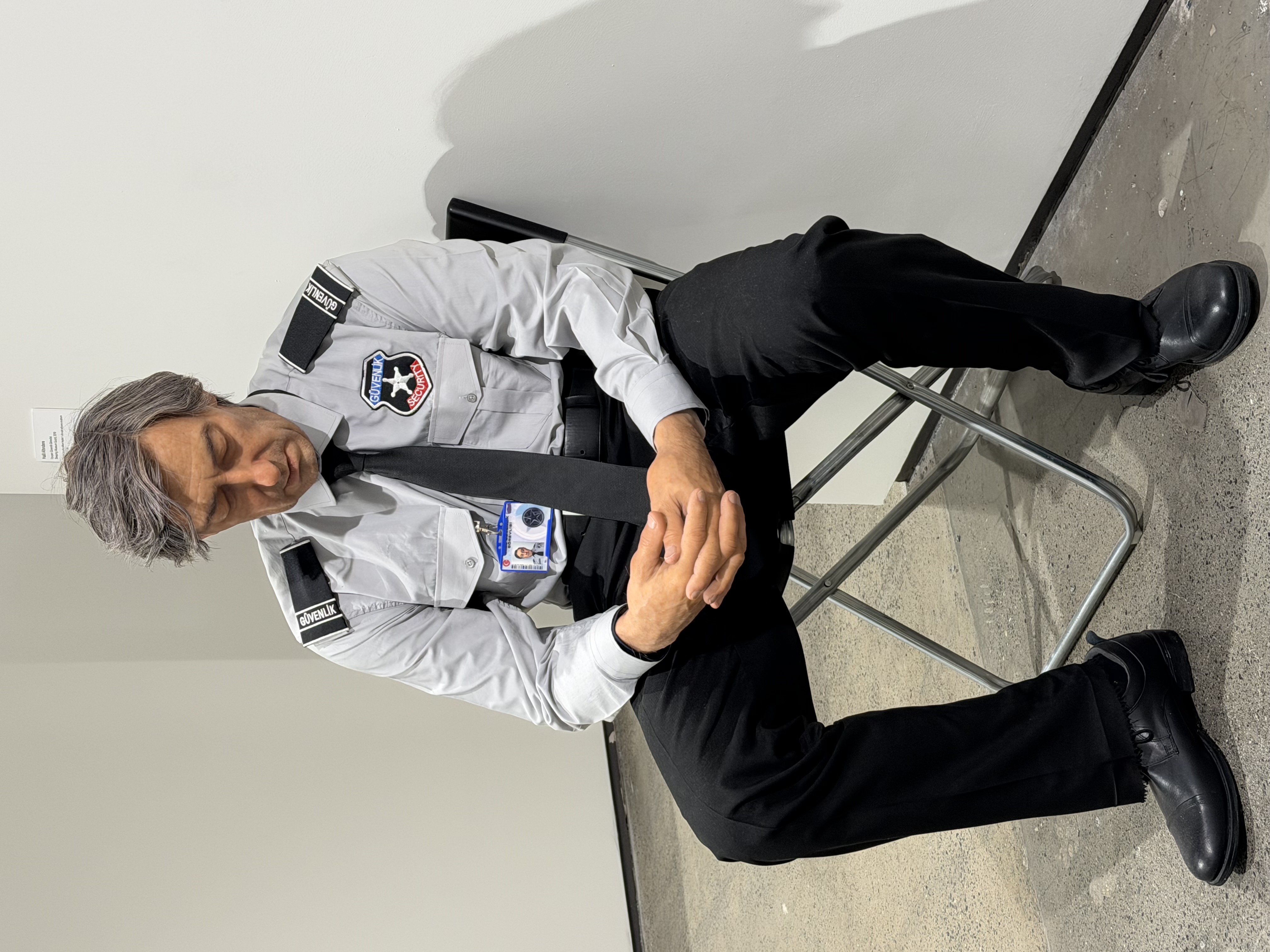
Sleeping Museum Guard, 2019
EXHIBITION PHOTOS